String art & installations
3D Constructions
Room 02 · Catalogued June 2026 · Text Lode Vercammen
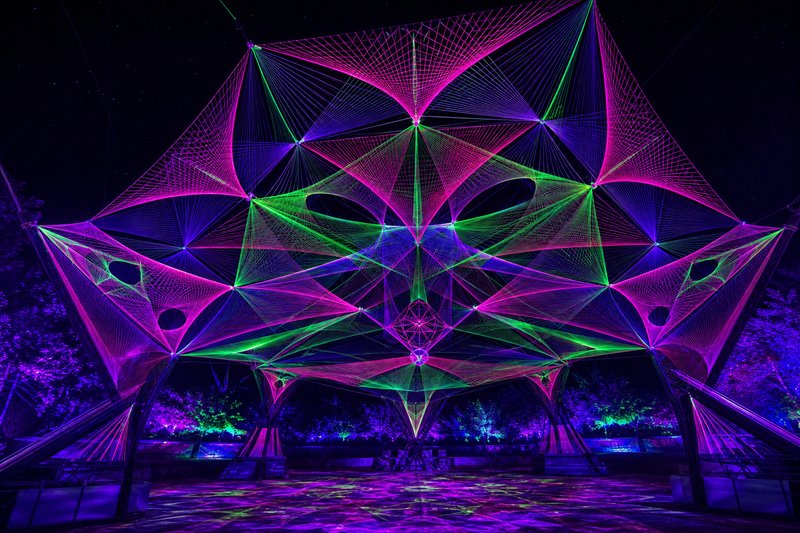
String art at a psychedelic festival is architecture you can see through. Kilometres of fluorescent cord, tensioned between poles, trees and scaffolding, form floating polyhedra, tunnels, webs and canopies over the dance floor. Under blacklight the cord reads as pure line: geometry drawn directly into the night air. Decor crews call these pieces 3D constructions, and they have become the most distinctive structural element of the style.
From gallery experiment to dance floor
Making volume out of line is an old idea. Naum Gabo and the constructivists built stringed sculptures in the 1920s, and mid-century mathematics classrooms used curve stitching to show how straight lines can describe curves. Festival string art picked these principles up and scaled them: what fits on a gallery plinth as a 40-centimetre study becomes a 20-metre canopy when the material is UV-reactive cord and the frame is a stage rig.
The psytrance circuit adopted string work in the late 1990s and 2000s because it solves a practical problem beautifully. Open-air dance floors are large, dark volumes with nothing overhead. Cord installations fill that volume with visual structure at very low weight, pack into a duffel bag, and survive weather that would destroy paper or foil work.
Geometry as a working method
Most constructions start from a small set of forms: polyhedra such as icosahedra and star tetrahedra, radial webs, hyperbolic saddles and long spiral tunnels. These are not arbitrary choices. Straight cord under tension naturally describes ruled surfaces, so designs based on them stay taut and read cleanly from every angle. Builders plan the piece as a sequence of anchor points and crossing orders, often on paper or in a 3D sketch, before a single knot is tied.
Colour behaves structurally too. Alternating cord colours by layer separates the geometry under UV light, and white or fluorescent yellow cord carries furthest across a large site.
Tension, knots and rigging discipline
The material list is short: UV-reactive braided cord, climbing-grade anchor slings, carabiners, and elastic shock cord where the structure needs to absorb wind. The craft is in the tensioning. Every line pulls on every other, so crews work in passes, bringing the whole piece up to tension evenly the way one tightens a drum head. Anchor points on trees are padded, rig points on scaffolding are load-checked, and anything hanging over people follows the same safety logic as stage lighting.
A medium canopy takes a two-person crew a day to install. Large signature pieces, with several kilometres of cord, can occupy a team for most of a festival build week.
Reading a construction from the floor
For a dancer, a good string piece organises the night. The canopy marks where the floor ends, sightlines run along the main cords toward the stage, and the geometry gives the light rig something to carve. Watch one for a while and the design logic shows itself: radial webs centre attention, tunnels pull movement through a space, and overhead polyhedra make a flat field feel like a room. Crews talk about this openly - the piece is furniture for a crowd first and sculpture second.
Scale also explains the economics. Cord is cheap, light and reusable, so a small crew with two duffel bags can transform a volume that would cost a fortune to fill with built structures. That efficiency is why string work spread from psytrance to general festival production, club interiors and museum lobbies, usually carrying its fluorescent palette with it.
Where the form sits in the wider craft
String constructions rarely stand alone. They frame the painted backdrops behind the stage, catch the beams of the light rig, and give projection artists surfaces to play across. The best dance floors are composed as a single environment in which cloth, cord and light answer each other. That composition, more than any individual object, is what audiences remember as the look of a festival.
Frequently Asked Questions
What cord is used for festival string art?
Braided polyester or nylon cord with fluorescent dye, typically two to four millimetres thick. It holds tension without much stretch, survives rain and sun, and glows strongly under UV light. Elastic shock cord is added where a structure needs to flex in wind.
How are string installations attached safely?
Through the same rigging logic as stage equipment: rated slings and carabiners on load-checked scaffold points, padded wraps on trees, and no single line whose failure would drop the piece on the crowd. Crews tension the work in even passes so no anchor carries a surprise load.
Why do the shapes look mathematical?
Because straight cord under tension naturally forms ruled surfaces - the same family of geometry used in curve stitching and in constructivist sculpture since the 1920s. Polyhedra, webs and hyperbolic saddles stay taut and legible, so builders keep returning to them.
How long does a big piece take to build?
A dance floor canopy is usually a one-day job for two riggers. Large signature installations with kilometres of cord can take a small team most of a build week, plus several hours of careful de-rigging so the cord comes down untangled and reusable.
Is string art reused between events?
The cord and hardware are, constantly. The exact form usually is not, because every site has different anchor points and distances. Crews travel with spools and rebuild a design adapted to each venue, which keeps the work site-specific by nature.