Visionary canvas
Paintings
Room 03 · Catalogued June 2026 · Text Lode Vercammen
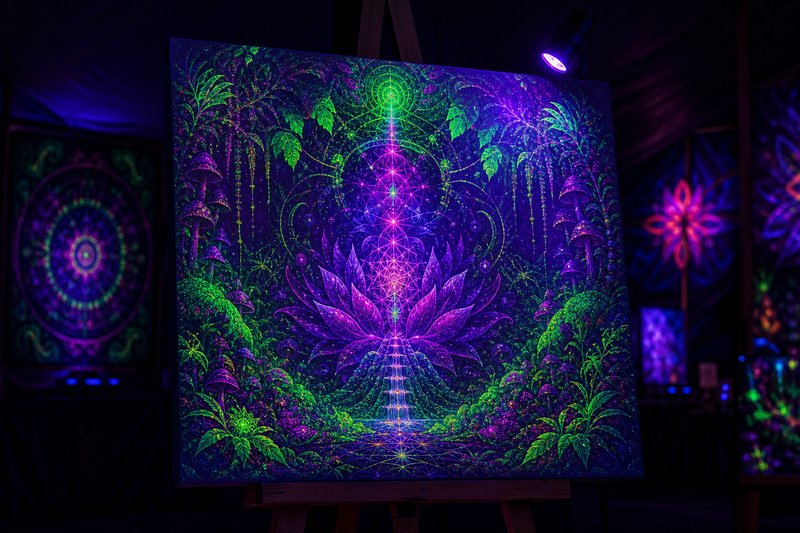
Behind the party decor stands a painting tradition with serious lineage. Visionary and psychedelic painting - detailed, symbolic, often built around inner experience rather than observed scenes - has run parallel to official art history for over half a century, and the festival circuit has become one of its most important exhibition spaces. This page follows the canvas side of the culture: where it comes from, who shaped it and how it is made and shown today.
Two roots: Vienna and San Francisco
One root is European. In post-war Vienna, Ernst Fuchs and the School of Fantastic Realism revived Renaissance glazing technique for dreamlike, mythological imagery, training a generation of painters in slow, layered oil work. The other root is American and faster: the San Francisco poster explosion of 1966 to 1971, when artists such as Wes Wilson and Victor Moscoso pushed vibrating complementary colours and melting letterforms into mainstream view through concert posters for the Fillmore and Avalon ballrooms.
Visionary painting inherited the first tradition's craft and the second's palette. Alex Grey's anatomical light-body paintings, widely known from Tool album artwork, brought the genre a global audience from the 1990s onward, and Peruvian painter Pablo Amaringo showed how a specifically Amazonian visual cosmology could be rendered in dense, luminous gouache.
What makes a painting psychedelic
Subject matter alone does not do it. The genre's working traits are technical: extreme value contrast so forms appear lit from within, complementary colour vibration, recursive and fractal detail that rewards long viewing, and compositional symmetry borrowed from mandala and icon painting. Many festival painters add a literal layer of fluorescence, mixing UV-reactive pigments into highlights so the canvas reads one way in daylight and another under blacklight - a double life the backdrop painters turned into an entire craft.
The live painting stage
Since the mid-2000s, live painting has become a fixture of psychedelic festivals. Painters work on stage or in dedicated art zones across the length of the event, canvas in progress, palette under a headlamp, while the audience wanders past at any hour. The format suits the genre: detailed work takes days, and watching an image accrete over a weekend gives festivalgoers a relationship with the finished piece no gallery opening can match. Completed canvases are usually auctioned or sold on site.
Technique: how the glow is built
The luminous quality that defines the genre is mostly a matter of layering. Painters working in the Fuchs lineage build images in thin transparent glazes over a bright ground, so light passes through the paint film, bounces off the ground and returns through the colour - the same optics that make Renaissance panels seem lit from behind. Acrylic painters approximate the effect with translucent layers and hard value control; gouache painters like Amaringo relied on dense, high-key colour and meticulous edges. In every case the discipline is the same: darks kept deep and clean, lights reserved and protected, detail resolved to the edge of what the eye can hold.
That workload shows in the calendar. A major visionary canvas routinely takes months, which is why live-painted festival pieces, finished in days, tend to be looser and why many painters keep both a fast performance practice and a slow studio practice running in parallel.
Collecting and showing the work
Original canvases circulate through festival art auctions, artist websites and a handful of specialised galleries and museum projects dedicated to visionary art. Prints and tapestry editions carry the imagery further at accessible prices. For display, the practical advice is simple: strong colour holds up in ordinary light, and any piece with UV highlights earns a small blacklight bar on a dimmer. Treated that way, a festival painting moves indoors without losing its character, one more room in the same continuous gallery this site documents.
Frequently Asked Questions
What is visionary art in one sentence?
Painting that depicts inner experience - mystical, symbolic or perceptual - with deliberate, craft-heavy technique, rather than depicting the outer world as observed. The term covers artists from Ernst Fuchs and the Vienna School to Alex Grey and contemporary festival painters.
How is psychedelic painting different from poster art?
The 1960s poster movement was graphic design for print: flat inks, letterforms, fast production. Psychedelic painting is slower easel work in oil, acrylic or gouache, usually layered and highly detailed. They share a palette and a history, but the craft and purpose differ.
Do festival painters really paint during the event?
Yes. Live painting zones are standard at larger psychedelic festivals: artists work on stage across several days, and visitors watch the canvas develop in real time. Finished pieces are typically auctioned or sold at the end of the event.
Are UV-reactive paints used on canvas too?
Often. Many painters mix fluorescent pigments into highlight passages, so the work shows a second palette under blacklight. Collectors who own such pieces usually add a small UV lamp to the room to switch between the two readings.
Where can visionary painting be seen outside festivals?
Through artist studios and websites, festival art auctions, dedicated galleries and museum projects focused on the genre, and print editions. A few major artists, Alex Grey among them, run permanent exhibition spaces of their own.