Projection & digital
Visuals & Digital Art
Room 04 · Catalogued May 2026 · Text Lode Vercammen
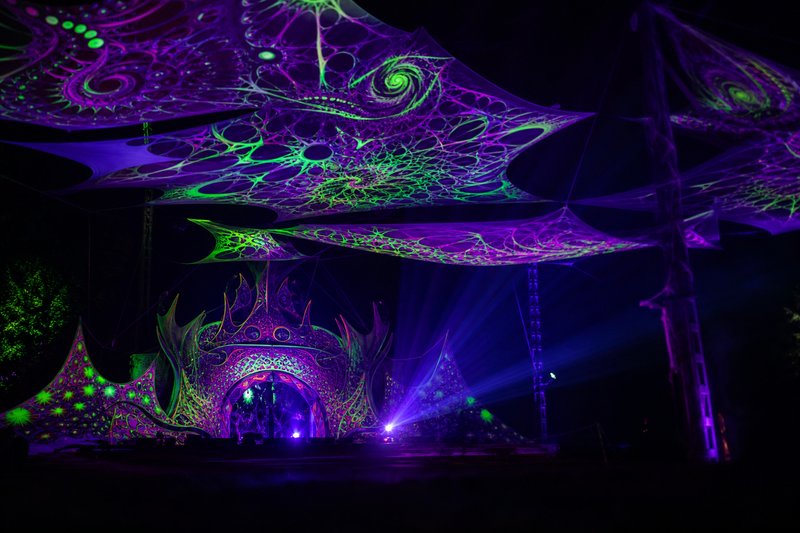
The newest layer of the psychedelic dance floor is made of light. Projected visuals - generative patterns, video collage, mapped animation - move across stages, backdrops and string work all night, driven live by a VJ who mixes imagery the way the DJ mixes sound. Digital art is the youngest of the crafts documented here, and the one changing fastest.
Liquid light: the analogue ancestors
Live visuals predate the software by decades. The liquid light shows of 1960s San Francisco and London projected coloured oil and water sandwiched between glass clock faces on overhead projectors, pulsing dye blobs across bands like Jefferson Airplane and Pink Floyd. The same era experimented with film loops and strobes. The principle those shows established still governs the craft: visuals are performed, not played back, and they answer the music in real time.
From video feedback to VJ software
Analogue video brought feedback loops - a camera pointed at its own monitor generates endlessly recursive tunnels - and the 1990s rave circuit ran them through video mixers alongside early computer graphics. Software then absorbed the whole toolkit. Winamp's MilkDrop visualiser introduced millions of listeners to real-time audio-reactive graphics. Dedicated VJ applications such as Resolume turned clip triggering, effects and output mapping into a live instrument, and node-based environments like TouchDesigner opened fully generative, custom-built visual systems to festival stages.
A modern psytrance VJ set is typically a hybrid: prepared loops and 3D renders, live generative layers reacting to the audio signal, and camera feeds, all mixed and routed to projectors in real time.
Projection mapping the decor
The decisive technique of the last fifteen years is projection mapping: warping projector output so it lands precisely on physical objects rather than a flat screen. Mapped correctly, a painted backdrop appears to animate, a string canopy pulses along its own cords, and stage architecture dissolves and rebuilds itself in sync with the music. Mapping ties the older crafts and the digital layer into one composition, which is why decor crews and VJs plan sites together rather than competing for the same walls.
The generative turn
The most consequential recent shift is from playing clips to growing images. Generative systems - built in TouchDesigner, in shader code, or in custom software - produce visuals algorithmically, in real time, with the music's amplitude and frequency bands wired directly into the parameters. Nothing is pre-rendered; the imagery cannot repeat exactly, and a set becomes a performance of a system rather than a playlist of files. Fractal renderers deserve their own mention here: the deep-zoom Mandelbulb and flame-fractal animations that circulate through psytrance stages are computationally heavy to produce and instantly recognisable in style.
The practical effect on the craft is a widening split between VJs who curate and mix existing material and visual artists who program their instruments from scratch. Most large stages now book both, and the strongest sets usually come from pairs who rehearse together like a band.
Screens, projectors and restraint
LED panels are brighter than projectors and have taken over many main stages, but projection keeps advantages the panels lack: it covers irregular surfaces, disappears when dark, and costs far less per square metre of image. Most psychedelic festivals therefore run both - LED where daylight and throw distance demand it, projection everywhere texture matters.
The craft's open question is restraint. A dance floor already full of painted and constructed detail can drown in animation. The better VJs treat the decor as the score and the projector as one more instrument: light serving the space, not covering it.
Frequently Asked Questions
What does a VJ actually do?
A VJ performs the visual layer of an event live: triggering and mixing clips, steering generative graphics, applying effects and routing everything to projectors or LED walls in sync with the music. The role is performative - the imagery is composed in real time, not played from a file.
What software do festival VJs use?
Resolume is the standard for live clip mixing and output mapping; TouchDesigner covers custom generative systems; and tools like MilkDrop established the audio-reactive style many sets still reference. Most working VJs combine prepared renders with live layers.
What is projection mapping?
Warping and masking projector output so the image lands exactly on a physical object - a stage structure, a painted backdrop, a string installation - instead of a flat screen. Done well, the object itself appears to move, glow or dissolve in time with the music.
What were liquid light shows?
The 1960s ancestor of VJing: performers projected coloured oil and water pressed between glass on overhead projectors, creating pulsing organic patterns behind bands in San Francisco and London. They established live, music-reactive visuals as a performance craft.
Are LED walls replacing projectors at festivals?
On daylight main stages, largely yes - LED wins on brightness. But projection still covers irregular decor surfaces, vanishes when dark and costs far less per square metre, so psychedelic stages usually run both and map projection onto the physical artwork.